
Tamil Diaspora Publishes Analysis on Britain’s 1948 Constitutional Exit from Ceylon and Its Long-Term Impact on SL
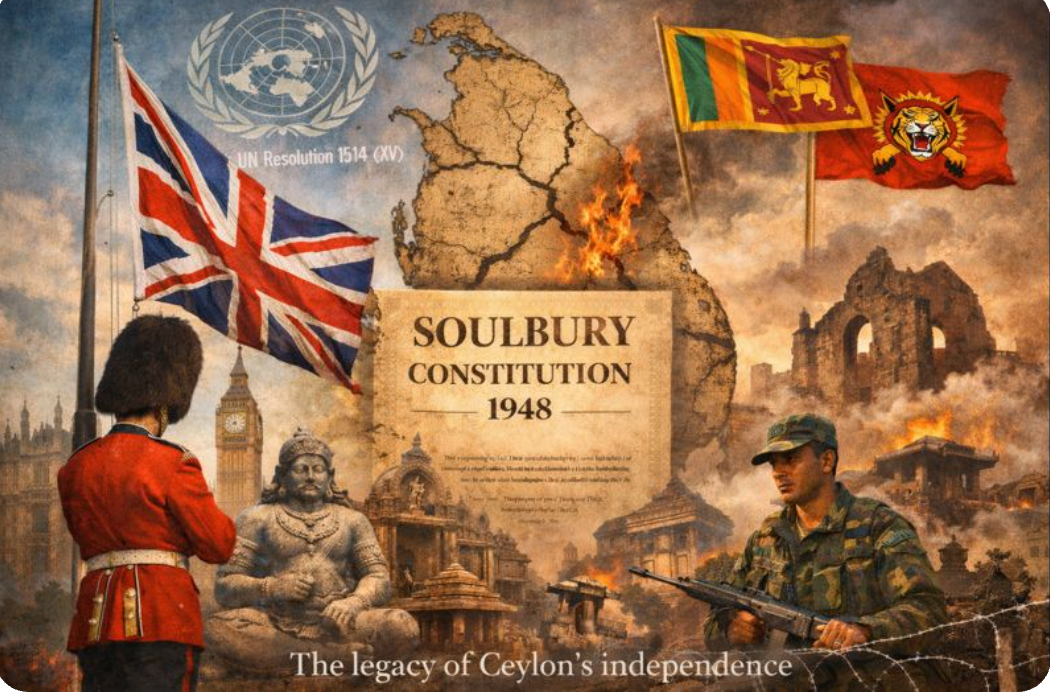
Why Britain’s 1948 constitutional exit from Ceylon ignored Tamil history and left a majoritarian state structure that still shapes Sri Lanka today.”
NEW YORK, NY, UNITED STATES, December 31, 2025 /EINPresswire.com/ -- Britain’s constitutional exit from Ceylon in 1948 proceeded from a fundamental historical misreading of the island. The Tamil people are among the island’s most ancient and continuous inhabitants, with documented political, cultural, and civilizational presence long predating colonial rule. This continuity is reflected across archaeological findings, classical Tamil literary sources, epigraphic records, and early foreign accounts of the island. Yet British administrators failed to engage seriously with this history. Instead, they accepted and institutionalized a modern Sinhala national identity that had emerged through layered historical processes involving Yaksha traditions, Nagar communities, North Indian influences, and South Indian trading populations. By collapsing this complexity into a single majoritarian national framework, Britain disregarded the island’s plural political inheritance and shaped a constitution detached from historical reality.— Editor, Tamil Diaspora News
As Sri Lanka continues to struggle with unresolved ethnic conflict, militarization, and democratic backsliding, it is therefore necessary to re-examine a foundational but rarely scrutinized moment: Britain’s constitutional exit from Ceylon in 1948.
This is not an exercise in nostalgia or blame-shifting. It is a constitutional reckoning.
Through the Soulbury Constitution, Britain transferred power to a unitary state structure that failed to provide effective safeguards for plural political communities. While independence was achieved peacefully on paper, the constitutional design privileged majoritarian rule without entrenched minority protections, laying institutional foundations for exclusion rather than equality.
The architects of that transition—British ministers, colonial administrators, and constitutional advisers—are no longer alive. But the constitutional logic they embedded remains very much alive.
Scholarly research has demonstrated that ethnicity in Sri Lanka was not simply inherited from ancient history but was administratively produced and consolidated under colonial governance, particularly through census practices, electoral design, and early twentieth-century constitutional reforms. Colonial debates over whether Ceylon consisted of multiple political communities or a single dominant nation were never resolved democratically. Instead, they were settled administratively in favor of a single national framework.
This legacy must be assessed in light of evolving international law. In 1960, the United Nations General Assembly adopted Resolution 1514 (XV), the Declaration on the Granting of Independence to Colonial Countries and Peoples, affirming self-determination as a universal right and rejecting political arrangements that perpetuate domination under new forms. While Sri Lanka’s independence preceded this declaration, the principles it codified became the global benchmark for evaluating decolonization outcomes. Yet no meaningful effort was made to review or remedy constitutional settlements—such as Sri Lanka’s—that entrenched majoritarian rule and denied equal political status to distinct peoples.
Britain’s decolonization process prioritized administrative continuity and short-term stability over constitutional justice. Minority concerns were acknowledged rhetorically but were not secured structurally. There were no binding power-sharing guarantees, no entrenched protections against demographic domination, and no sustained international oversight after independence.
The consequences are well documented: disenfranchisement, constitutional breakdowns, civil war, mass displacement, and unresolved accountability for grave human rights violations. These outcomes are inseparable from the terms of exit chosen by the departing colonial power.
Decolonization is not finished when a flag is lowered. It is finished only when the political architecture left behind does not produce permanent inequality.
That conversation is long overdue.
Editor
Tamil Diaspor News
+1 516-308-2645
email us here
Legal Disclaimer:
EIN Presswire provides this news content "as is" without warranty of any kind. We do not accept any responsibility or liability for the accuracy, content, images, videos, licenses, completeness, legality, or reliability of the information contained in this article. If you have any complaints or copyright issues related to this article, kindly contact the author above.
